
A Graduate’s Journey to the Physical Heart of the Internet
By Emmanuel Alliu
Having spent a year at LONAP, I still find it surreal reflecting on the sheer volume of opportunities, conversations, projects, and hands-on learning I’ve been part of. I am immensely grateful for every bit of it.
My background is in software engineering, focused primarily on programming and software-related problems. Heading into this role, my networking knowledge was minimal - just the basics of how the Internet functions and a few fundamental topologies. It wasn’t until my second year of Computer Science that I explored the area deeper using Cisco Packet Tracer, learning the OSI and TCP/IP models, and configuring LANs and WANs in a sandbox environment. While I didn’t think much of it at the time, it laid the foundation for an unexpected career direction.
When I joined LONAP, the Network Operations Manager Rob Lister began teaching me the core principles of our network infrastructure: how Internet Exchange Points (IXPs) advertise routes between members and keep local traffic local to reduce latency for Internet users across London. The defining moment came when Rob took me to our data center in the Docklands near East India Telehouse. Seeing where the Internet physically lives sparked an immediate sense of fascination and inspiration.
Many people picture the Internet as an abstract cloud, but in reality, it consists of hundreds of server racks, switches, routers, firewalls, and miles of copper and fiber-optic cabling. As technicians and network engineers, our job is to keep these vast infrastructures running smoothly. Whenever a major platform goes down, engineers step in to diagnose bad ports, physical faults, or configuration bugs. Strong collaboration and tenacity are essential skills across systems engineering, IT support, and network administration.
To strengthen my theoretical foundations, the Managing Director Richard Irving encouraged me to enroll in the CCNA curriculum. The course combines foundational theory with practical simulations in Packet Tracer. This environment allows me to test ideas, analyse network behavior, and troubleshoot without risking production hardware. The concepts directly translate to my work at the data center, whether I am setting up cross-connects or diagnosing hardware and connectivity issues. Mastering these protocol layers helps me analyse issues systematically, evaluate performance improvements, and work backward to identify root causes. Balancing rigorous technical study with day-to-day deliverables is challenging, but that perseverance is fundamental to becoming an effective network engineer.
One of my primary projects has been upgrading the infrastructure for our BGP Training Labs. This two-day course teaches participants core BGP concepts including ASN configuration, prefix lists, route maps, and policy control for inbound and outbound traffic, as well as route server peering within an IXP context. My goal was twofold: speed up the deployment of router instances and build an automated validation system to streamline troubleshooting for students. Navigating tool selection, early iterations, and design setbacks required considerable trial and error, but with Rob’s mentorship, we’ve made steady progress. Here is a preview of the lab environment:
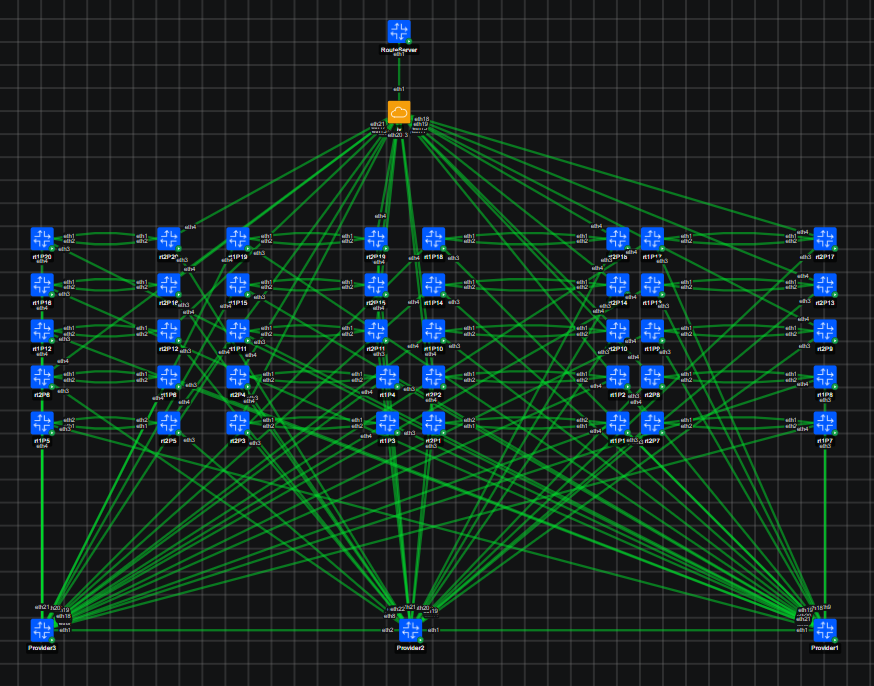
Recently, I have been working with Netcalibre, a LONAP contractor (and member), to deepen my understanding of physical-layer operations outside the exchange environment. This role has sharpened my technical communications, requiring me to explain complex networking concepts clearly to clients. Alongside shadowing colleagues on support calls and site surveys, I picked up practical skills like fusion splicing—joining optical fibers to ensure low-loss, high-bandwidth connections. Learning how these delicate splices are secured inside protection trays within comms cabinets gave me a clearer perspective on physical redundancy and physical infrastructure maintenance across data centers.
No two days at LONAP are identical, and every week brings new technical challenges. From attending industry events like NetLdn, Euro-IX, and NLNOG Days to collaborating with engineers across the field, the experience has been deeply rewarding. If I had to summarise my first year in a single word, it would be riveting.
 Share on Facebook
 Share on Twitter
 Share on LinkedIn